
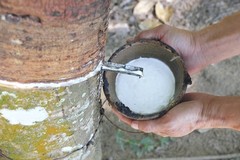
Every rubber gasket, seal, and molded component started as a milky white fluid dripping from a tropical tree. That journey from sap to durable, high-performance material is one of the more fascinating transformations in modern manufacturing. As a rubber manufacturer in Minneapolis, MN, we often hear the same curious question from customers and students alike: how is natural rubber processed into the reliable parts that end up in machines, vehicles, and industrial equipment?
The short answer is that it takes several carefully controlled stages, each one building on the last. The raw latex collected in rubber-producing regions cannot be used in its original form for most industrial applications. It has to be harvested, stabilized, compounded, shaped, and cured before it becomes a finished component. Understanding this process helps explain why quality rubber manufacturing is as much a science as it is a craft.
It Starts With the Tree
Natural rubber comes primarily from the Hevea brasiliensis tree, grown in warm, humid climates across Southeast Asia, Africa, and parts of South America. Workers make a careful incision in the bark in a process called tapping, which allows the latex to seep out and collect in cups attached to the trunk. This latex is a suspension of rubber particles in water, and it contains the natural polymer that gives rubber its remarkable elasticity and resilience.
Once collected, the latex is quickly treated to keep it from coagulating too soon. Ammonia or another preservative is often added so the material stays stable during transport. From there, it can be processed in a couple of different directions depending on the end use, either kept in liquid latex form for products like gloves and balloons, or coagulated and dried into solid blocks and sheets for industrial manufacturing.
How Is Natural Rubber Processed From Latex Into Usable Raw Material?
When manufacturers ask how is natural rubber processed into a workable raw material, the answer centers on coagulation and drying. Acids such as formic acid are added to the latex to make the rubber particles clump together and separate from the water. The resulting coagulum is then pressed through rollers to remove excess moisture and form thin sheets.
These sheets are typically dried using air or smoke in large curing houses, which produces what the industry calls ribbed smoked sheets. Alternatively, the rubber may be processed into technically specified grades through crumbling, washing, and oven-drying, then compressed into bales. Either way, the goal is the same: create a clean, consistent, solid raw material that can be shipped to manufacturers and compounded into specific formulations. This dried natural rubber is the starting point for nearly everything that happens on a production floor.
Compounding: Turning Raw Rubber Into a Recipe
Raw natural rubber on its own is rarely suitable for demanding applications. It needs to be mixed with other ingredients to achieve the right hardness, strength, temperature resistance, and durability. This stage is called compounding, and it is where a lot of the engineering expertise comes into play. Manufacturers blend the rubber with curing agents, fillers like carbon black, antioxidants, accelerators, and processing oils to create a compound tailored to a specific job.
The mixing itself happens in internal mixers or on open mills, where heat and mechanical shearing work the ingredients into a uniform mass. Precision matters here because even small changes in the formula can dramatically alter how the finished part performs. Our rubber compounding and milling in Minneapolis, MN focuses on developing and refining formulations for different applications.
Getting the recipe right is why two rubber parts that look identical can behave very differently. One compound might be engineered to resist oil and heat in an engine bay, while another is designed to stay flexible in freezing conditions. This is the point in the process where a part truly becomes purpose-built.
Shaping the Material
Once a compound is mixed and ready, it moves into the shaping stage. There are several ways to form rubber into a usable shape, and the method depends on the geometry, volume, and tolerances required. Common approaches include:
- Compression molding, where the compound is placed into a heated mold cavity and pressure forces it into shape.
- Transfer and injection molding, which push the material into closed molds for more complex or high-volume parts.
- Extrusion, which forces the compound through a die to create continuous profiles like tubing, cords, and seals.
- Calendering, which rolls the rubber into flat sheets or applies it to fabric backings.
These shaping techniques are at the heart of custom work. For many industrial customers, rubber molding in Minneapolis, MN is the stage where their specific part comes to life, formed to exact dimensions that fit a larger assembly. The choice of method has a real impact on cost, precision, and production speed, which is why experienced manufacturers evaluate each project individually.
Vulcanization: The Step That Makes Rubber, Rubber
Perhaps the most important chemical transformation in the entire process is vulcanization. Discovered in the 1800s, this step uses heat and curing agents, most often sulfur, to create cross-links between the long polymer chains in the rubber. Before vulcanization, rubber is soft, sticky, and prone to deforming permanently. After it, the material becomes strong, elastic, and able to return to its original shape after being stretched or compressed.
During molding, heat is applied to trigger this reaction while the part is held in its final form. The temperature, pressure, and cure time all have to be carefully managed so the cross-linking develops fully without over-curing. This is the moment that answers the deeper version of how is natural rubber processed into something genuinely durable, because vulcanization is what gives finished rubber its signature combination of flexibility and toughness.
Finishing, Inspection, and Quality Control
After curing, parts usually need some finishing work. Excess material known as flash is trimmed away, surfaces are cleaned, and dimensions are verified against specifications. In many cases, secondary operations such as precision grinding bring a part into tight tolerance. Our capabilities include rubber grinding in Minneapolis, MN for applications that demand smooth surfaces and exact measurements, which matters a great deal in sealing and bearing components.
Quality control runs throughout the entire operation, not just at the end. Samples may be tested for hardness, tensile strength, and resistance to heat or chemicals to confirm the compound performed as designed. Our manufacturing processes and equipment help produce reliable parts that meet application requirements.
So when someone asks how is natural rubber processed, the honest answer is that it travels through a long and precise chain of steps, from a drop of latex in a tropical grove to a finished component engineered for a specific purpose. Each stage depends on the ones before it, and small details in compounding, shaping, and curing determine how well the final part will perform.
For manufacturers and businesses throughout Minneapolis and the surrounding areas, understanding this process helps clarify why experience and consistency matter so much when choosing a partner. If you have a project in mind or simply want to talk through the right material and method for your application, we invite you to contact our team for a quote and to learn how we can bring your rubber component from concept to completion.