
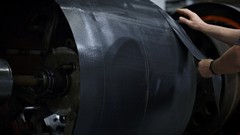
Every rubber part you encounter, from the seal on a car door to the gasket inside industrial equipment, began as raw material transformed by specialized machinery. The journey from a shapeless blend of polymers to a precise, functional component involves several stages of controlled heat, pressure, and shaping. As a custom rubber manufacturer in the Minneapolis area, we work with these machines every day, and understanding what a rubber manufacturing machine actually does helps explain why quality and consistency matter so much in this industry.
Rubber is not a simple material to work with. Its properties change dramatically depending on how it is mixed, heated, and formed. A single misstep in temperature or timing can affect the durability and performance of the finished part. That is why the equipment used in rubber production is engineered for precision, and why the people operating it need real expertise to get repeatable results.
The Starting Point: Mixing and Compounding
Before any shaping happens, raw rubber has to be blended with other ingredients to give it the right characteristics. This is where compounding begins. Natural or synthetic rubber is combined with additives like curing agents, fillers, and stabilizers. Each ingredient plays a role, whether it improves resistance to heat, adds strength, or changes flexibility. The recipe, often called a compound formulation, is tailored to the specific demands of the final product.
A rubber manufacturing machine dedicated to this stage, such as an internal mixer or a rubber mill, works the ingredients together under controlled conditions. The mill uses two rotating rollers that turn at slightly different speeds, kneading the material and distributing additives evenly throughout the batch. Getting this blend right is critical because uneven mixing leads to weak spots and inconsistent performance. Our approach to rubber compounding and milling is built around achieving that even, reliable consistency batch after batch.
Shaping the Material: Molding and Forming
Once the compound is properly mixed, it moves to the shaping stage. This is where a rubber manufacturing machine gives the material its final form, and there are several methods depending on the part being produced. Compression molding places a measured amount of rubber into a heated mold cavity, then applies pressure to force the material into the shape while heat cures it. Transfer molding and injection molding use different mechanisms to move the rubber into the mold, offering advantages for complex shapes or high-volume runs.
The mold itself is a precision tool, machined to exact tolerances so that every part comes out identical. Temperature and pressure are carefully controlled throughout the cycle because rubber cures, or vulcanizes, when exposed to the right combination of heat and time. Vulcanization is the chemical process that turns soft, pliable rubber into a durable, elastic material capable of holding its shape under stress. Without proper curing, a part would either fall apart or fail to perform as intended.
Curing and Vulcanization Explained
Vulcanization deserves a closer look because it is the heart of what makes rubber useful. When raw rubber is heated with curing agents, cross-links form between the polymer chains. These cross-links give the material its familiar bounce, resilience, and resistance to deformation. A rubber manufacturing machine controls this reaction with remarkable precision, holding the material at a specific temperature for a specific duration.
Too little curing leaves the part soft and prone to failure. Too much can make it brittle. This balance is why experienced operators and well-maintained equipment matter so much. The machinery monitors and adjusts conditions in real time, ensuring the finished part meets the performance requirements it was designed for. For businesses in Minneapolis and the surrounding areas that depend on rubber components, this level of control translates directly into products that last.
Finishing: Trimming, Grinding, and Inspection
After molding and curing, most rubber parts need finishing work. Excess material, known as flash, can form at the seams of the mold and must be removed. Depending on the part, this happens through trimming, tumbling, or rubber grinding to achieve smooth edges and exact dimensions. Grinding equipment refines surfaces and brings parts within tight tolerances when the application demands a precise fit.
Inspection follows every stage of production. Parts are checked for dimensional accuracy, surface quality, and material integrity. Some applications require testing for hardness, tensile strength, or resistance to specific conditions like chemicals or extreme temperatures. This quality control step is where the discipline of the whole process pays off, catching any variation before a part ever reaches a customer. You can see the range of products and processes we handle on our rubber manufacturing capabilities page.
Why Machine Precision Shapes the Final Product
It is easy to think of a rubber manufacturing machine as a single piece of equipment, but in practice it is a coordinated system of tools working in sequence. Each stage depends on the one before it. If the compound is mixed unevenly, no amount of careful molding will fix the problem. If the mold is not held at the right temperature, the curing step suffers. This interdependence is why manufacturers invest so heavily in equipment maintenance, calibration, and skilled operators.
The benefits of well-run machinery show up in the details that customers care about most:
- Consistency across large production runs, so every part performs the same way
- Tight tolerances that ensure parts fit correctly the first time
- Durable components engineered to withstand the specific stresses of their application
- Efficient production that keeps lead times reasonable and costs predictable
Rubber components serve an enormous range of industries, from automotive and aerospace to medical devices and industrial equipment. Each application places different demands on the material, and the machinery has to accommodate those differences. A gasket for a food processing plant has different requirements than a vibration mount for heavy machinery, and the production process adapts accordingly. If you want to see the sectors we support, our industries served page offers a helpful overview.
Bringing It All Together
Understanding what a rubber manufacturing machine does reveals why this work is equal parts science and craftsmanship. From the initial mixing of raw materials to the precise control of heat and pressure during molding and curing, every step influences the quality of the final part. The finishing stages, including trimming and grinding, put the last touches on a component built to specification. When all of these steps work together, the result is a reliable product that performs exactly as intended.
For manufacturers and businesses throughout Minneapolis and neighboring communities, partnering with an experienced rubber producer means gaining access to this whole system of expertise and equipment. The machinery is only as good as the people running it and the processes behind it, which is why consistency and quality control remain central to everything we do.
If you have a project that calls for custom rubber components, or if you simply want to learn more about how your parts would be made, we would be glad to talk through the process with you. Reach out to our team to discuss your specifications and get a quote tailored to your needs.