
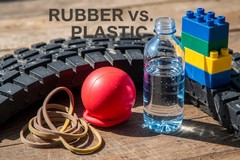
Walk through almost any factory floor, hardware store, or product design meeting and you will hear the words "rubber" and "plastic" used almost interchangeably. They can look similar, feel similar, and sometimes even serve the same purpose. But the question that comes up more often than you might expect is a surprisingly good one: is rubber a plastic? At Hiawatha Rubber, a company built around rubber manufacturing in the Minneapolis region, we get asked this all the time by engineers, buyers, and curious customers who want to make the right material choice for their parts.
The short answer is no, rubber is not a plastic, even though the two share some traits and are often grouped together as polymers. Understanding what actually separates them can save you money, prevent product failures, and help you specify the right material the first time. Let's break down what makes rubber and plastic genuinely different, and why that difference matters when you are designing or sourcing a component.
Is Rubber a Plastic? The Core Distinction
To answer the question directly, is rubber a plastic in the technical sense? Both rubber and plastic belong to the broad family of polymers, which are long chains of repeating molecular units. That shared ancestry is why people confuse them. However, the way those molecules behave under heat and stress sets them worlds apart.
Most plastics are thermoplastics, meaning they soften when heated and harden when cooled, and this cycle can often be repeated. Rubber, by contrast, is typically an elastomer that undergoes a process called vulcanization, which permanently links its molecular chains together. Once rubber is vulcanized, it will not simply melt back down and reform the way a thermoplastic will. This one difference in molecular structure drives nearly everything else about how these materials perform.
Elasticity, Flexibility, and Recovery
The most noticeable practical difference is how each material responds to being stretched, compressed, or bent. Rubber is famous for its elasticity. You can stretch it dramatically, and it snaps back to its original shape. That resilience is why rubber is the go-to material for seals, gaskets, bushings, vibration dampeners, and countless other parts that need to flex repeatedly without wearing out.
Plastic can be flexible too, but its flexibility works differently. Many plastics hold a rigid shape and, if pushed too far, they crack, deform permanently, or snap rather than bounce back. Some engineered plastics are designed to bend, yet they rarely match the repeated stretch-and-recover behavior of a quality rubber compound. When a part needs to absorb shock, maintain a tight seal under pressure, or endure constant movement, rubber usually wins.
How Heat and Chemicals Affect Each Material
Temperature performance is another area where the two materials diverge. Because most plastics soften with heat, they can lose their shape or strength in high-temperature environments. Vulcanized rubber tends to hold its form across a wider temperature range, which is one reason it shows up under the hood of vehicles and inside industrial equipment where heat is constant.
Chemical and weather resistance depends heavily on the specific compound in both categories, but rubber is often formulated to resist oils, solvents, ozone, and UV exposure. This is where the science of compounding becomes essential. By blending base polymers with fillers, curing agents, and other additives, a manufacturer can tune rubber to meet very specific demands. If you want to see how much control goes into that process, our overview of rubber compounding and milling shows how the right recipe can make or break a part's durability.
Manufacturing Methods Are Not the Same
Even the way these materials are shaped reflects their differences. Thermoplastics are frequently injection molded at high speed, melted and cooled in rapid cycles that suit very high volumes. Rubber parts, on the other hand, often require heat and pressure to cure the material into its final, cross-linked form. The tooling, timing, and process controls differ significantly.
This is why choosing an experienced partner matters. A shop that understands elastomers will approach a project differently than one geared toward thermoplastics. Our rubber manufacturing capabilities are built specifically around the demands of elastomers, from precise compound control to the molding and finishing steps that give a rubber component its final performance characteristics. When a customer asks whether rubber and plastic are interchangeable in production, the honest answer is that they rarely are, because the equipment and expertise are tailored to each material.
When to Choose Rubber Over Plastic
So how do you decide? The right choice depends on what the part actually has to do. Rubber tends to be the better option when your component needs to seal, flex, grip, cushion, or endure vibration and repeated stress. Plastic often makes sense when you need rigidity, dimensional stability, or a lightweight structural part that does not need to stretch.
Here are a few situations where rubber typically outperforms plastic:
- Seals and gaskets that must maintain a tight fit under pressure or temperature swings
- Vibration dampeners and mounts that absorb shock and reduce noise
- Grips, pads, and rollers that need traction and a soft, forgiving surface
- Flexible tubing, bellows, and diaphragms that bend without cracking
Of course, the answer is not always obvious, and many products combine both materials to get the best of each. That is where working with knowledgeable engineers pays off. If you are unsure which direction to take, browsing the industries we serve can give you a sense of how different sectors apply rubber components to solve real problems.
Bringing It All Together
Circling back to the original question, is rubber a plastic? The takeaway is that while both are polymers and can look alike, they are fundamentally different materials with different molecular structures, different responses to heat and stress, and different manufacturing needs. Rubber's ability to stretch and recover, resist heat, and be finely tuned through compounding makes it irreplaceable for a huge range of applications, while plastic earns its place where rigidity and high-volume simplicity matter most.
Getting the material choice right early in a project prevents costly redesigns and premature failures down the road. Whether you need a durable seal, a custom molded part, or help deciding between materials in the first place, our team is happy to talk through the options. Our capabilities as a rubber mill in Minneapolis, MN, allow us to control quality from raw compound all the way to finished component, and our precision rubber molding in Minneapolis, MN, and neighboring communities serves customers who need parts that perform exactly as specified.
If you have a project on the horizon or simply want a second opinion on material selection, reach out to Hiawatha Rubber for a quote or a conversation about your requirements. We are proud to support manufacturers throughout Minneapolis and the surrounding areas, and we are always glad to help you figure out whether rubber, plastic, or a combination of the two is the smart choice for your next part.