
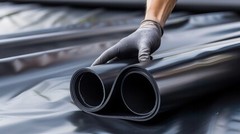
More than half of the rubber used in modern manufacturing never came from a tree. While natural latex still plays an important role, the vast majority of today's industrial components rely on synthetic rubber, a family of man-made elastomers engineered to perform in conditions where natural materials would quickly break down. As a custom rubber manufacturer in Minneapolis, we see every day how these materials quietly keep equipment, vehicles, and machinery running reliably across countless industries.
Understanding what synthetic rubber is, why it matters, and where it shows up can help you make smarter decisions about the parts and products you depend on. Whether you are sourcing seals for heavy equipment or specifying gaskets for a sensitive chemical process, the right elastomer makes a measurable difference in performance and longevity. Let's break down the fundamentals.
What Is Synthetic Rubber?
Synthetic rubber is a category of artificial elastomers produced primarily from petroleum byproducts through a process called polymerization. Chemists link small molecules, known as monomers, into long, flexible chains that mimic and often surpass the elastic qualities of natural rubber. By adjusting the raw ingredients and the compounding process, manufacturers can create materials with very specific properties, from extreme heat resistance to exceptional chemical stability.
The story of synthetic rubber dates back to the early twentieth century, when wartime shortages of natural latex pushed scientists to develop reliable alternatives. Today there are dozens of distinct types, each formulated for particular demands. Common examples include nitrile, which resists oils and fuels, EPDM, which stands up to weather and ozone, silicone, which tolerates wide temperature swings, and neoprene, prized for its balanced durability. This variety is precisely what makes synthetic materials so valuable in manufacturing.
The Benefits That Set Synthetic Rubber Apart
The appeal of synthetic rubber comes down to consistency and control. Because it is engineered rather than harvested, its properties can be tailored and reproduced batch after batch. That predictability is critical for manufacturers who need parts that perform identically every time, whether they are producing a hundred units or a hundred thousand.
Beyond consistency, synthetic rubber often outperforms natural rubber in demanding environments. Many formulations resist degradation from oils, solvents, acids, and extreme temperatures that would cause natural latex to crack, swell, or dissolve. This resilience translates directly into longer service life and fewer failures in the field. For applications exposed to sunlight, ozone, or harsh weather, certain synthetic compounds hold up for years where other materials would deteriorate within months.
There is also a practical sourcing advantage. Because production does not depend on agricultural harvests, supply tends to be more stable and less vulnerable to climate or seasonal disruptions. Combined with the ability to fine-tune hardness, flexibility, and chemical resistance, these benefits explain why so many engineers specify synthetic materials from the start. The expertise behind rubber compounding and milling is what allows a manufacturer to dial in exactly the right blend for each job.
Common Applications Across Industries
Synthetic rubber appears in far more places than most people realize. From the seals in your car's engine to the gaskets in food processing equipment, these elastomers are foundational components in nearly every corner of modern manufacturing. Their adaptability means a single material family can serve wildly different purposes depending on how it is formulated and molded.
In the automotive and transportation sector, synthetic rubber is essential for hoses, belts, seals, vibration dampeners, and weatherstripping. The oil and chemical resistance of compounds like nitrile makes them indispensable under the hood, where temperatures rise and fluids are constantly present. In construction and infrastructure, EPDM and similar materials provide durable roofing membranes, expansion joints, and weather seals that endure decades of exposure.
Industrial and agricultural equipment relies heavily on custom molded components to keep machinery sealed, cushioned, and protected from contaminants. Medical and food-grade applications call for silicone and other specialized formulations that meet strict safety and cleanliness standards. Even consumer products, from footwear to electronics, incorporate synthetic rubber for grip, insulation, and shock absorption. The range of industries served by custom rubber manufacturing speaks to just how versatile these materials truly are.
How Synthetic Rubber Parts Are Made
Turning raw synthetic polymer into a finished component is a careful, multi-step process. It begins with compounding, where base polymers are blended with fillers, curing agents, and additives to achieve the desired performance characteristics. This stage is where much of the engineering happens, because the exact recipe determines how the final part will behave under stress, heat, or chemical exposure.
Once compounded, the material is shaped using one of several molding methods. Compression molding, transfer molding, and injection molding each suit different part geometries and production volumes. The material is then cured, a process that uses heat and pressure to cross-link the polymer chains and lock in the elastic properties. Precision at every step ensures the finished part meets tight tolerances and performs as intended.
This is where experienced custom rubber manufacturing makes the difference. Choosing the correct compound, designing the right mold, and controlling the cure cycle all require technical knowledge built over years of practice. A well-made part fits perfectly, seals reliably, and lasts for its full expected lifespan, while a poorly specified one can lead to costly failures down the line.
Choosing the Right Material for Your Project
Selecting the ideal synthetic rubber starts with understanding the operating environment. A few key questions guide the decision, and thinking through them early saves time and expense later.
- Temperature range: Will the part face extreme heat, cold, or frequent cycling between the two?
- Chemical exposure: Will it contact oils, fuels, solvents, acids, or cleaning agents?
- Environmental factors: Will it sit outdoors in sunlight, ozone, or moisture?
- Mechanical demands: Does it need to flex, compress, resist abrasion, or absorb vibration?
Answering these questions narrows the field considerably and points toward the best compound. For example, nitrile excels around petroleum products, silicone shines across broad temperature ranges, and EPDM resists weathering beautifully but struggles with oils. No single material is best for everything, which is exactly why working with knowledgeable specialists pays off. Our team can review your application and recommend a formulation that balances performance, durability, and cost.
Partnering With a Trusted Local Manufacturer
Synthetic rubber is one of the unsung heroes of modern manufacturing, delivering the chemical resistance, temperature tolerance, and consistency that natural materials simply cannot match. From automotive seals to industrial gaskets to specialized medical components, these engineered elastomers keep critical systems running smoothly across virtually every industry. Understanding the benefits and matching the right compound to your application is the key to getting the most from your parts.
For businesses throughout Minneapolis and the surrounding areas, having a reliable local source for precision components means faster turnaround, closer collaboration, and parts built to exact specifications. When you need high-quality rubber molding in Minneapolis, MN, working with an experienced team ensures your project is handled with the care and expertise it deserves. You can learn more about our full range of capabilities or read what our customers say in our customer reviews.
If you have a project that calls for custom synthetic rubber components, we would be glad to help you find the right solution. Reach out to Hiawatha Rubber to discuss your needs, request a quote, or ask questions about which materials and processes best fit your application. The right partner makes all the difference in getting durable, dependable parts that perform exactly as expected.